
Read the report before you book the bridge.
The mission is unforgettable. The report is the point. This is the document your principal, your teachers, and your board read after a mission day. Three pages carrying the numbers one day produced, the TEKS mapping labeled as what it is, three named coaching targets, and the limits in writing. The full Principal's Brief and the eight page Cohort Comparison Report take one short form.
One voice carried most of the mic time in every measured crew. Each of the 10 measured crews had a single dominant speaker. Building balanced participation is a clear, measurable goal for a second deployment.
CONFIDENCE: HIGH // ROLE-LABELED TRANSCRIPTS, 10 OF 10 CREWS
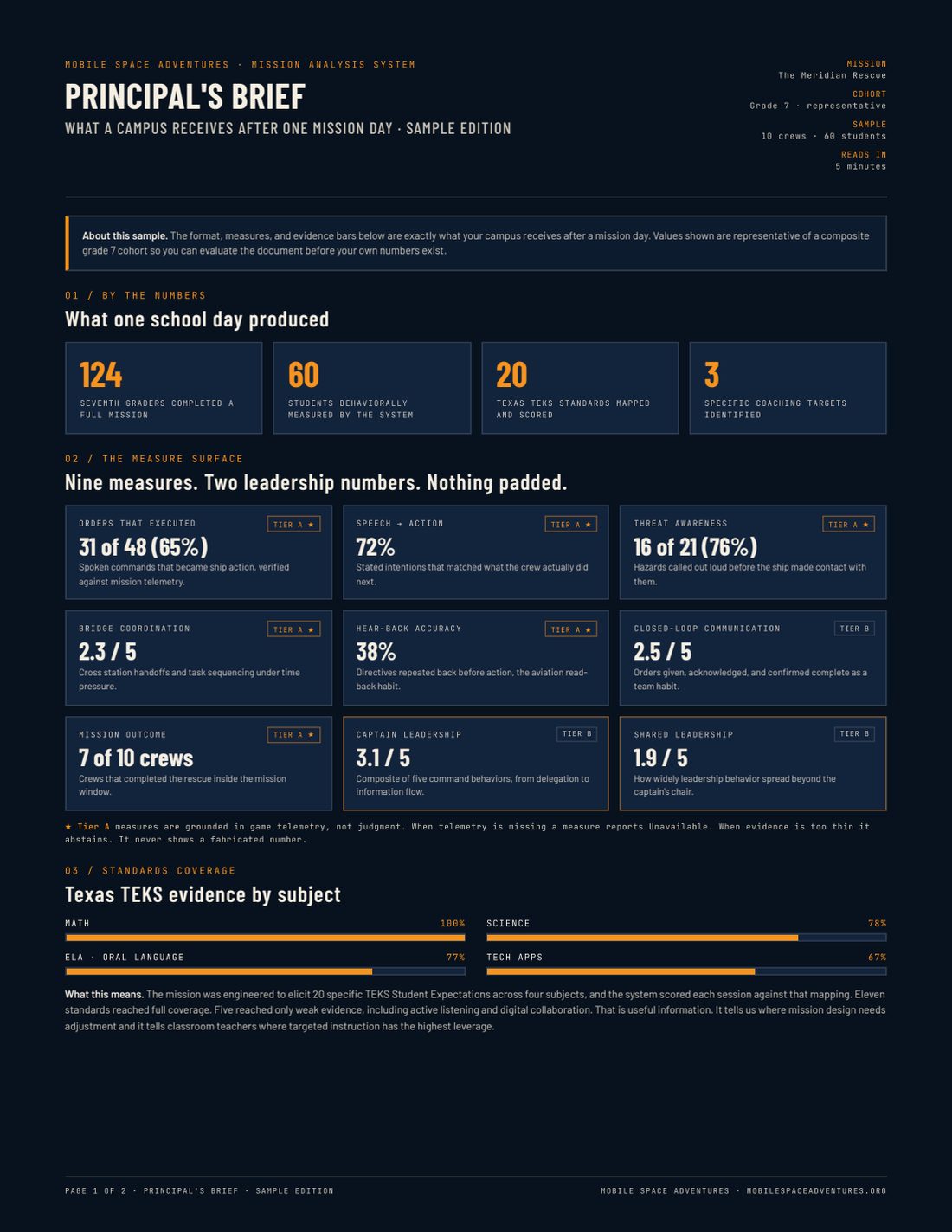
The excerpt and the page above come from the three page brief behind the form. It uses representative cohort data so you can judge the format before your own numbers exist.
Get the full Principal's Brief
The brief reads in five minutes. The eight page Cohort Comparison Report downloads beside it. Both instant, on the next page.
That email did not look right. Check it and press the button again.
Three pages, itemized
Page 1 // What the day produced
- The headline numbers. 124 students flown, 60 behaviorally measured, 3 coaching targets named.
- The TEKS mapping, labeled honestly. The Student Expectations the mission was built to elicit, listed as what they are: science practices and recurring themes, ELA oral language, math proportionality, technology applications. No subject percentages, and one line stating that no content pairing was recorded.
- What the mapping means. Five expectations reached Medium evidence in 4 or fewer of the 10 measured sessions. That is where targeted instruction has the highest leverage, and where the mission design needs tuning before the next deployment.
Pages 2 and 3 // Findings, limits, next steps
- Three findings a principal can act on. A strength, 10 of 10 crews strong in scientific argumentation. A coaching target, active listening at Medium evidence in 4 of 10. A cohort pattern, one voice per bridge.
- The honest limits, in writing. No growth claims from one day. No causal claims without a comparison group. The sample limit named outright, 60 of 124 students, because one bridge lost audio. Formative numbers, not a summative grade. The candor is why the report survives skeptical readers.
- The next steps page. A 30 minute debrief, written confirmation for aggregate data use, and the second deployment that turns a baseline into a directional read on growth.
Procurement will ask for more than a brief.
The full Cohort Comparison Report adds definitions for every measure, crew by crew behavioral profiles with top performers and coaching opportunities, and the complete TEKS table with what to tune before the next deployment. It downloads beside the brief on the next page, and we walk it through live in a 15 minute briefing, so methodology questions get answered in the room.
Both reports are one short form away.
Instant download, no inbox wait. All processing happens locally on our equipment inside your building. No student data leaves your campus, and no PII is retained after reports are delivered.